Proudly serving Phoenix, Scottsdale, Glendale, Peoria, Paradise Valley, Tempe & surrounding areasCall or Text 24/7: 480-264-8603
Aerial drone view of a suburban neighborhood and desert landscape with Saguaro cacti in Phoenix, AZ.

Ceiling Fan Installation, Replacement & Mounting Services in Phoenix, AZ

Phoenix Electrician Co. installs, repairs, and replaces ceiling fans for homes and commercial properties across Phoenix, Arizona. Our electricians handle existing-box swaps, new fan-rated boxes, new wiring, switch and remote controls, and indoor or wet-rated outdoor models. We also provide electrical repair and troubleshooting, lighting installation, panel upgrades, circuit breaker repair, outlet and switch installation, whole-home rewiring, EV charger installation, and commercial electrical work. Every recommendation starts with the actual ceiling, circuit, and fan rather than a one-size-fits-all scope.

Phoenix summers can push attic temperatures past 150 degrees while outdoor air stays above 100 degrees for months, so a dependable fan is practical cooling support. A loose, humming, wobbling, or dead fan can point to an unbalanced assembly, incompatible control, unsafe box, or wiring problem. We send a licensed electrician who checks the circuit, confirms the box is rated for a spinning fan's dynamic load, and anchors the support to framing instead of drywall. Work follows the National Electrical Code as adopted by the City of Phoenix, with permits pulled when the scope requires them.

Our electricians are licensed through the Arizona Registrar of Contractors and carry liability coverage on every job. After inspecting the ceiling and existing wiring, we provide straightforward pricing before work begins.

Phoenix Electrician Co. provides ceiling fan installation throughout Phoenix and the surrounding metro, including Scottsdale, Tempe, Mesa, Glendale, Chandler, and Peoria.

★ ★ ★ ★ ★4.9/5 Average Rating · 20+ Years of Experience · Thousands of Customers Helped · Licensed & Insured · Residential & Commercial

Ceiling Fan Installation Options & Benefits

What Professional Ceiling Fan Installation Includes

A standard installation visit can include removing the old fan, checking the existing ceiling box, installing a fan-rated box when needed, mounting and balancing the new fan, and wiring its switch or remote. The support must be rated for the moving load of a spinning fan and anchored to framing or an approved fan brace.

We inspect accessible wiring, confirm proper breaker sizing, and test the fan's rotation, speed settings, and controls before leaving. If damaged or undersized wiring is uncovered, the electrician explains the correction required before completing the connection.

Existing-wiring swaps, new electrical runs, vaulted ceilings, and outdoor installations require different scopes. We look at the actual conditions first, quote a flat price, and handle any permit and inspection required for new circuit work.

Benefits of Proper Ceiling Fan Installation

Professional installation protects the fan, the ceiling, and the branch circuit while helping the unit deliver steady airflow. It also gives the electrician a chance to correct unsafe support or wiring before a small symptom becomes a larger electrical problem.

  • A fan-rated box secured to framing or an approved brace
  • Circuit and breaker sizing checked before final connection
  • Balanced blades and tightened hardware for smoother operation
  • Switch, remote, rotation, and speed settings tested
  • Old fan removal and haul-away unless you want to keep it
  • Existing wiring reused when safe to avoid unnecessary drywall openings
  • Damp- or wet-rated equipment selected for bathrooms and covered patios
  • Installation intended to support a typical 10-15-year fan service life
Installation and Repair

Ceiling Fan Installation Services

From a simple replacement on usable wiring to a new circuit for a room without a ceiling fixture, we match the work to the structure and electrical conditions. Residential, commercial, indoor, outdoor, repair, and urgent fan-circuit needs are all evaluated by a licensed electrician.

Existing-Wiring Fan Installation

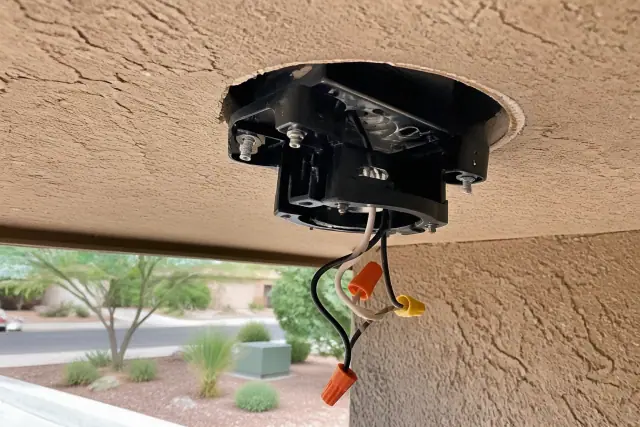
Technician installing a ceiling fan mounting bracket and wiring on a stucco wall in Phoenix, AZ.

Many Phoenix subdivision homes built from the 1970s through today already have a ceiling box wired for a light fixture. We test the circuit, confirm the box is fan-rated, replace it when necessary, and use the existing wiring when it is safe and compatible.

Request Estimate

New Wiring and Fan-Rated Boxes

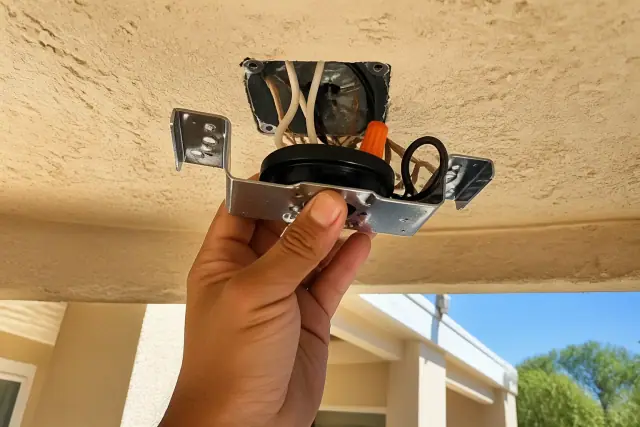
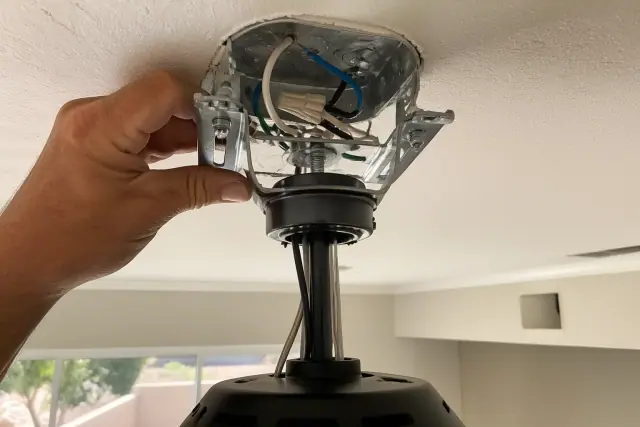
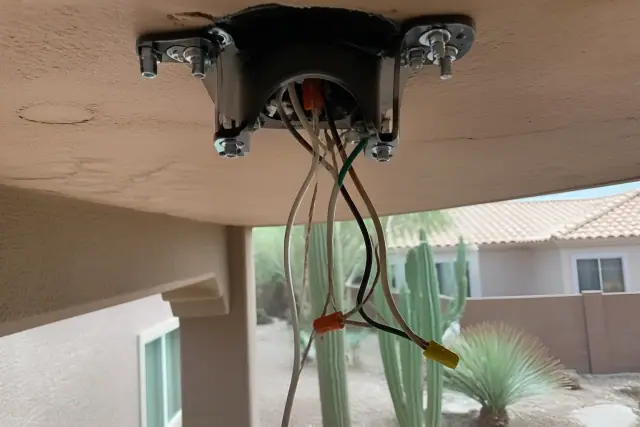
New wiring and fan-rated mounting bracket installed in a ceiling box at a jobsite in Phoenix, AZ.

Rooms without a ceiling fixture may need a new run from the panel or a nearby junction box. Depending on circuit load, we route new 14 or 12 AWG NM-B cable, install a box anchored to a joist or approved fan brace, add a dedicated switch, and size the breaker correctly; City of Phoenix permits and inspections are handled when required.

Request Estimate

Ceiling Fan Repair and Replacement

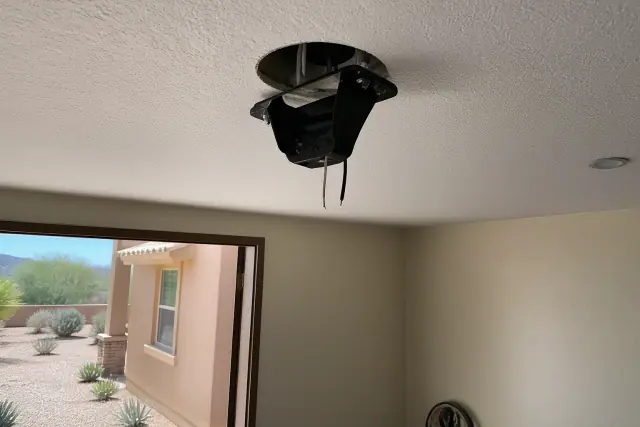
Technician installing a ceiling fan mounting bracket and wiring in a home in Phoenix, AZ.

Loose blade brackets, failed capacitors, worn motor bearings, bad pull-chain switches, and loose wire nuts can cause wobbling, humming, or loss of power. We diagnose the cause and explain whether a targeted repair or a replacement offers the better value for the fan's condition.

Request Estimate

Residential Ceiling Fan Installation

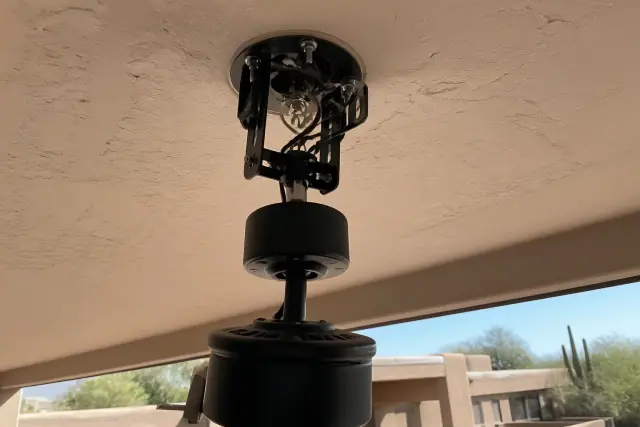
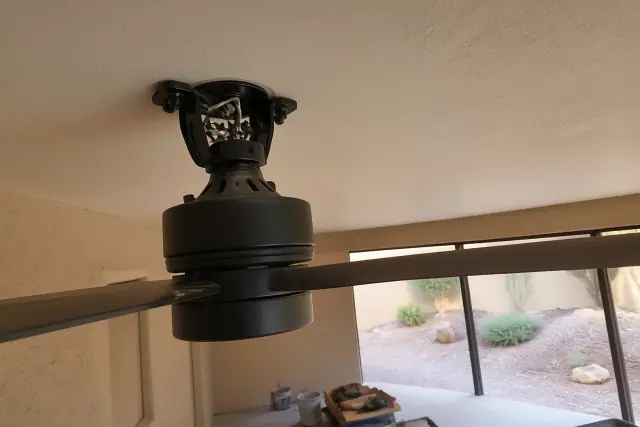
Ceiling fan mounting bracket and wiring installation inside a home in Phoenix, AZ, with desert landscaping visible outside.

Bedrooms can benefit from quiet DC motor fans with wall or remote controls, while open living rooms and kitchens often need longer downrods and 52-60-inch blade spans for more even airflow. We size and mount fans for the room, ceiling height, control preference, and location rating.

Request Estimate

Commercial Ceiling Fan Installation

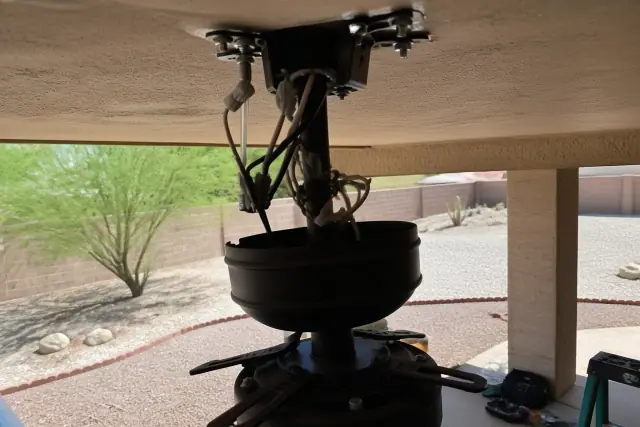
Technician installing a commercial ceiling fan mounting bracket and wiring in a Phoenix, AZ building.

Warehouses, restaurants, and retail spaces may require high-CFM fans, extended downrods, industrial mounts, and equipment rated for continuous duty. Connections can involve three-phase or dedicated 120/240V circuits depending on the building's electrical service, so we evaluate the available power before specifying the installation.

Request Estimate

Rapid Fan Circuit Troubleshooting

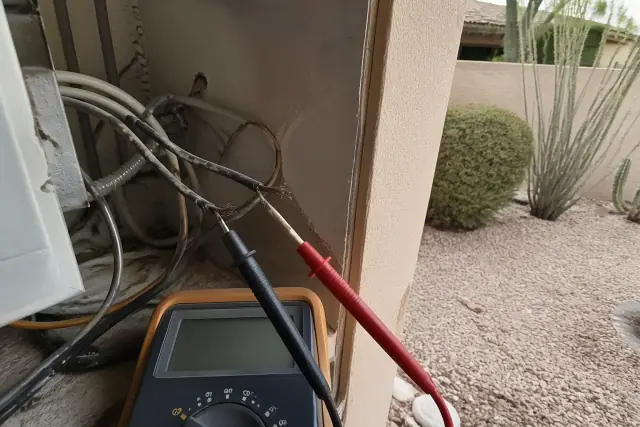
Multimeter testing damaged wires during ceiling fan circuit troubleshooting in a Phoenix, AZ utility closet.

A fan circuit that sparks, trips its breaker, or stops responding needs prompt electrical attention. Call the dispatch line with the symptoms and, if available, the fan model or circuit breaker number; active hazards are prioritized, and same-day openings are used when available.

Request Estimate
Fan Selection

Ceiling Fan Types and Options

Motor type, blade span, ceiling height, moisture rating, and control style all affect comfort, installation scope, and price. We help match the fan to the room and verify that its box, wiring, breaker, and switch can support the selected equipment.

Ceiling fan mounting bracket and electrical wiring installation in a Phoenix, AZ home.

Standard AC Motor Fans

Standard AC motor fans are a familiar choice for bedrooms, living spaces, and straightforward replacements. We confirm that the fan, control, and existing circuit are compatible before mounting and testing the assembly.

  • Suitable for many standard indoor fan replacements
  • Available with pull-chain, wall-switch, or remote operation
  • Requires a fan-rated control instead of an incompatible dimmer
  • Summer and winter rotation checked during final testing
  • Existing wiring reused only after the circuit and box pass inspection
Request Estimate
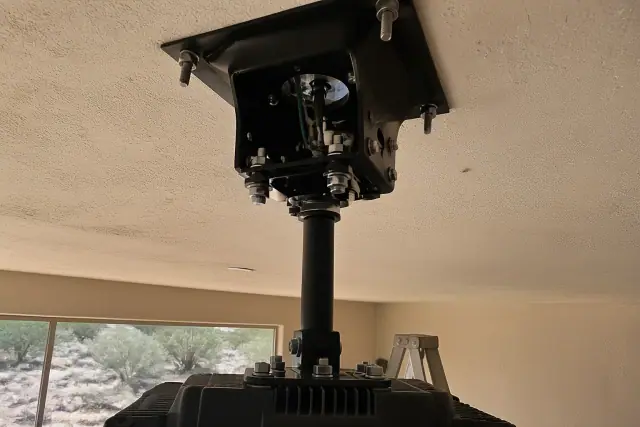
Technician installing a heavy-duty ceiling fan mounting bracket in a home in Phoenix, AZ.

High-Efficiency DC Motor Fans

DC motor fans offer quiet operation and efficient airflow, making them useful in frequently occupied rooms. Their energy profile can be especially relevant during a Phoenix cooling season that often runs six months long.

  • Run up to 70 percent more efficiently than standard AC motor units
  • Typically cost roughly $50-$100 more upfront
  • Can save about $50-$85 per fan annually
  • The added cost can pay back in approximately 2-4 years
  • Quiet motor performance suits bedrooms and other occupied rooms
Request Estimate
Mounting bracket and electrical wiring for a ceiling fan installation at a home in Phoenix, AZ.

Indoor, Damp-, and Wet-Rated Fans

The installation location determines the required fan rating. Standard indoor fans belong in dry rooms, while bathrooms, covered patios, and other moisture-exposed spaces need appropriately listed damp- or wet-rated equipment.

  • Indoor-rated fans for dry bedrooms and living areas
  • Damp-rated models for covered moisture-prone locations
  • Wet-rated models where direct moisture exposure is possible
  • UL or ETL listing checked as part of equipment review
  • Circuit and switch selected for the room's conditions
Request Estimate
Technician installing a ceiling fan mounting bracket and housing in a home in Phoenix, AZ.

Fan Size and Ceiling Height

Blade diameter, mounting height, and access influence both equipment choice and installation cost. We evaluate room proportions and downrod needs so the fan can move air without creating an uncomfortable gust or sitting too close to the floor.

  • 29-36 inches: typical fan cost $50-$150; typical install cost $100-$180
  • 42-44 inches: typical fan cost $75-$250; typical install cost $120-$220
  • 50-54 inches: typical fan cost $100-$400; typical install cost $150-$280
  • 56+ inches: typical fan cost $200-$700+; typical install cost $180-$350
  • Vaulted ceilings above 12 feet often need a longer downrod and extra labor
Request Estimate
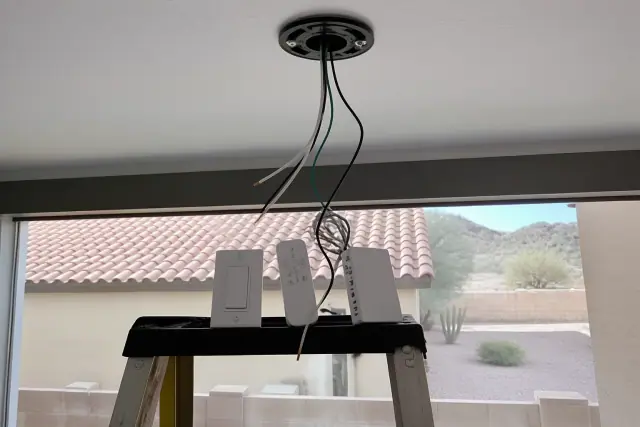
Ceiling fan controls and wiring at a residential jobsite in Phoenix, AZ.

Switch, Remote, and Smart Controls

Controls must be compatible with the fan motor and the available conductors. We can connect wall switches, manufacturer remotes, or supported smart controls while correcting incompatible dimmers or reversed wiring discovered during the work.

  • Wall controls for convenient speed and light adjustment
  • Remote controls for rooms without separate switch conductors
  • Smart-control integration when supported by the selected fan
  • Fan-rated switches used in place of incompatible light dimmers
  • Rotation direction and every speed setting tested before completion
Request Estimate
Finding the Right Fit

Choosing the Right Ceiling Fan Approach

The right approach depends on whether usable wiring and a fan-rated box already exist, along with ceiling height, room size, moisture exposure, motor preference, and control needs. Our electrician inspects those conditions, explains practical options, and prices the actual scope before installation starts.

Licensed, Code-Conscious Electricians

Our electricians hold licensing through the Arizona Registrar of Contractors and train to current National Electrical Code standards. That preparation matters when an installation exposes a bad box, shared neutral, overloaded circuit, or other branch-circuit issue that a simple fan hang would miss.

Phoenix-Area Installation Experience

We work across the Phoenix metro in properties ranging from historic bungalows near Encanto Park to newer construction in Ahwatukee. That local experience informs attic-routing choices, heat-rated cable selection, room sizing, and practical access planning, and every job carries liability coverage.

Straightforward, Upfront Pricing

A $60 fan-hang advertisement often assumes perfect wiring and may skip box-rating and permit-compliance checks. We first inspect the ceiling and electrical setup, then quote a flat price for the real scope so required corrections are clear before work begins.

Troubleshooting Help

Common Ceiling Fan Problems We Fix

Wobble, humming, intermittent controls, loss of power, breaker trips, and loose mounting each point to different mechanical or electrical causes. We trace the symptom to the fan, control, box, wiring, or circuit before recommending repair or replacement.

Request Troubleshooting

Unsafe or Loose Mounting

A fan attached to a standard light-fixture box or drywall alone can loosen under the dynamic load of spinning blades and may eventually pull free. We verify the box rating and secure it to framing or an approved brace.

Fan Wobble and Shaking

Wobble commonly comes from unbalanced blades, loose blade brackets, or a ceiling box that is not fully secured. We tighten, balance, and inspect the mounting assembly instead of treating movement as normal.

Humming or Noisy Operation

Humming may indicate an incompatible dimmer, failing capacitor, loose hardware, or a worn motor bearing. The electrician checks the control and fan components to identify whether a switch correction, repair, or replacement is appropriate.

Fan Will Not Turn On

A tripped breaker, failed pull-chain switch, loose wire nut, or control problem can leave a fan unresponsive. We test the circuit and connections before replacing equipment that may still be serviceable.

Repeated Breaker Trips

Repeated trips can signal an overloaded or incorrectly sized circuit, damaged wiring, or a fault in the fan or control. We check breaker sizing and the branch circuit because repeated resetting does not correct the condition and wiring can overheat.

Wrong Rotation or Control Response

Reversed wiring, a mismatched switch, or remote setup issues can produce the wrong response or rotation direction. We correct the connection and verify summer and winter rotation along with every available speed setting.

How It Works

Our Ceiling Fan Installation Process

The process starts with the ceiling, box, circuit, and fan rather than a preset installation assumption. Each step is designed to establish safe support, compatible wiring and controls, smooth operation, and a clean handoff.

01.

Inspect the Ceiling and Circuit

We review ceiling height and access, identify the circuit, test the existing wiring, and confirm whether the box is rated and anchored for a fan. After that inspection, we explain the scope and provide the price before work begins.

02.

Remove the Existing Fixture

With power safely isolated, we disconnect and remove the old fan or light fixture. The exposed box and conductors are then checked for loose connections, damage, support, and compatibility with the new fan.

03.

Install Support and Wiring

We install or reinforce the fan-rated box, correct usable wiring, or route a new circuit when the room has no electrical connection. New circuit work receives the properly sized breaker and any required City of Phoenix permit and inspection.

04.

Assemble, Mount, and Balance

The electrician assembles the selected fan, sets the appropriate downrod, makes the electrical connections, and secures the mounting hardware. Blades and brackets are aligned and balanced to reduce wobble.

05.

Connect Controls and Test

We connect the wall switch, remote receiver, or supported smart control and then test power, lighting, speed settings, and response. Rotation direction is verified for seasonal operation, and any unusual sound or movement is corrected before completion.

06.

Clean Up and Review the Work

We review the controls and basic care with you, clean the work area, and haul away the old fan unless you want to keep it. If an issue develops with our installation, call us so we can return and correct it.

Plan Your Installation

Schedule Your Ceiling Fan
Installation Consultation

Tell us whether you are replacing an existing fan, adding a fixture to a new location, troubleshooting a problem, or planning an indoor, outdoor, residential, or commercial installation. We will inspect the conditions, explain the electrical scope, and provide a firm quote before starting.

Installation Help

Ceiling Fan Installation FAQs

These answers cover common timing, permit, safety, cost, equipment, wiring, and maintenance questions for Phoenix ceiling fan projects. For an exact scope, an electrician needs to see the ceiling, support, circuit, and selected fan.

Call an Electrician

A straightforward swap using an existing fan-rated box typically takes one to two hours. Replacing the box, adding a brace, or running new wiring can require a half day, while an outdoor wet-rated installation may take longer depending on access.

A simple fan swap on existing wiring generally does not require a permit. Adding a new circuit, new box, or significant wiring changes typically does under City of Phoenix building code, and Phoenix Electrician Co. evaluates the scope, pulls the required permit, and schedules the inspection.

Most rooms can accommodate a fan when there is structural framing for a fan-rated box and adequate clearance, typically at least 7 feet from floor to blades. Bathrooms, covered patios, and other damp locations need a UL-listed damp- or wet-rated fan, and rooms without electrical wiring require a new circuit.

Installations follow the National Electrical Code as enforced by the City of Phoenix for box ratings, wire sizing, and circuit protection. Fans should carry a UL or ETL listing, and equipment used in moisture-exposed locations needs the appropriate damp or wet rating.

Installation generally runs $137 to $350 per fan and averages around $240, depending on fan type, ceiling height, and whether the existing wiring and box can be used. The fan itself can range from $50 for a basic 30-inch model to $700 or more for a large premium fan, and Phoenix Electrician Co. provides a firm quote after an on-site look.

A fan under 10 years old may be worth repairing when the problem is a switch, capacitor, loose bracket, or similar serviceable part. Fans older than 10-15 years with worn bearings, cracked blades, or outdated wiring are often better replacement candidates, and we explain which option fits the fan's condition.

Yes. Standard service includes disconnecting and taking down the old fan, inspecting the box and wiring underneath, and hauling the fan away unless you want to keep it for another room.

Yes, when the existing circuit, breaker, conductors, and ceiling box are safe and compatible. If the box was designed only for a light fixture, we replace it with a fan-rated box anchored to framing or an approved brace before mounting the fan.

Yes. We can route a new electrical line through attic space where possible to limit drywall openings, install a fan-rated box and dedicated switch, and connect the circuit to a properly sized breaker; this scope typically requires a permit in Phoenix.

Indoor fans are intended for dry rooms. Damp-rated fans suit covered areas exposed to moisture, while wet-rated models are required where more direct moisture exposure is possible; we match the fan rating to the bathroom, covered patio, or other installation location.

Standard AC motor fans are a familiar option for many rooms and replacements. DC motor fans generally offer quieter, more efficient operation but cost more upfront, so the better fit depends on room use, budget, controls, and how often the fan will run.

Clean the blades every few months to prevent buildup from affecting balance, and check the mounting screws annually, especially after monsoon season winds. If the fan begins to wobble, hum, or respond incorrectly, have the mounting, control, and wiring checked rather than ignoring the symptom.

Phoenix Electrician Co. installs ceiling fans throughout Phoenix and the surrounding metro. Supported service areas named for this service include Scottsdale, Tempe, Mesa, Glendale, Chandler, and Peoria.