Typical Cost Range
Replacement work is usually least expensive, while new wiring, finished-wall access, and dedicated high-voltage circuits move a job toward the upper end of the range.
Most licensed electricians charge between $100 and $450 to install a single outlet, but wiring access, outlet type, circuit work, and panel capacity can move the final price. Phoenix Electrician Co. prices the labor and materials required for the actual job so customers can understand the scope before work begins.
Replacement work is usually least expensive, while new wiring, finished-wall access, and dedicated high-voltage circuits move a job toward the upper end of the range.
Compare wall and attic access, wire length, voltage, amperage, breaker capacity, required protection, permit needs, and any drywall repair.
Confirm whether labor, materials, diagnostics, permit handling, testing, cleanup, and wall patching are included before comparing two prices.
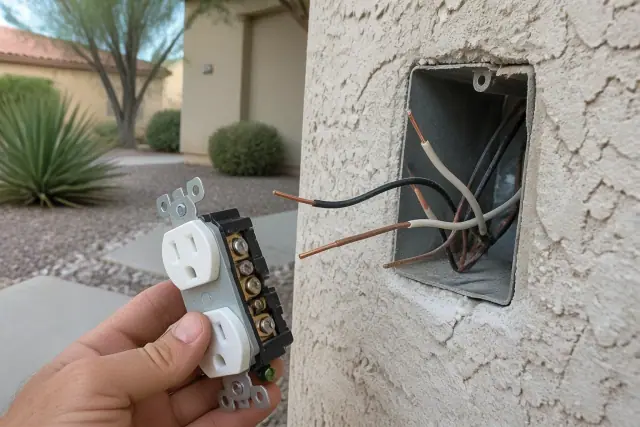
An electrician testing a standard receptacle before a like-for-like replacement. This illustrates the lower-labor case without new wiring or drywall cuts.
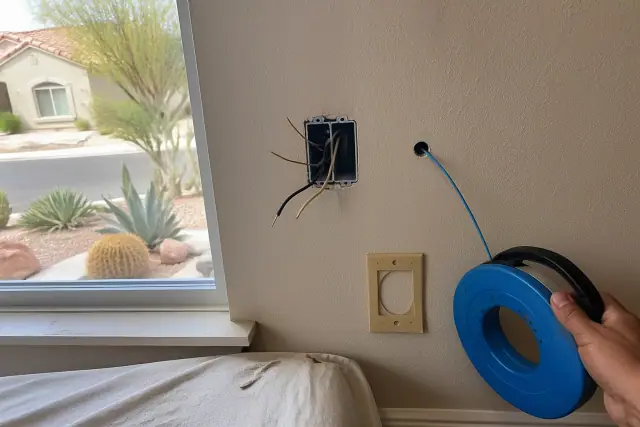
The path from the panel through an attic and down a finished wall. Access, wire length, and patching explain why a new location costs more than a swap.
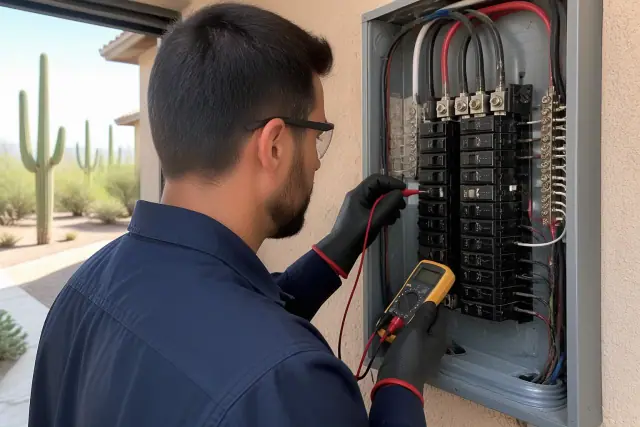
A panel-capacity check beside a dedicated 240V receptacle. Breaker space, circuit load, and wire gauge determine whether added electrical work is necessary.
A like-for-like device swap uses the existing box and circuit. Adding a location requires a route for cable from a suitable circuit or the panel.
Open framing or a clear attic path reduces labor. Finished walls, slab-on-grade construction, conduit, and patching make the installation more involved.
A dedicated dryer, range, welder, or EV charger circuit may require a load calculation, an added breaker, or a subpanel evaluation before installation.
Simple like-for-like outlet replacements generally do not require a Phoenix permit. New circuits and most rough-in work require permit handling and inspection.
| Outlet work | Typical Phoenix price | Key scope detail |
|---|---|---|
| Replace an existing standard outlet | $65-$150 | Usually 20-30 minutes once work begins |
| Repair a non-working or burnt outlet | $100-$200 | Circuit troubleshooting can raise the total |
| Add an outlet through an accessible wall | $132-$295; about $213 on average | A new wire run commonly takes 1-3 hours |
| Add an outlet with drywall cuts and patching | $300-$550 | Finished-wall access adds labor and repair work |
| Install a GFCI outlet | $150-$225 | Used where wet-location protection is required |
| Install a smart or USB outlet | $125-$225 | Existing wiring must be compatible |
| Rough in outlets with open walls | $75-$120 each | Multiple circuits can be run in one pass |
| Install a standard 220V/240V outlet | $175-$350 with panel capacity; toward $300-$450 if breaker or capacity work is needed | A straightforward job can take 1-2 hours; longer wire runs can take 3-5 hours |
| Install a welder or EV charger outlet | $250-$450 | May call for a 40-50 amp breaker, 6-gauge wire, and a panel evaluation |
A fair quote covers more than the receptacle itself. The common $50-$130 hourly range and $100-$150 minimum service fee account for travel, diagnostics, and an initial block of labor; $100 per hour is a common benchmark, while flat-rate pricing is also widely used for outlet work. Professional scope should include circuit diagnosis, code-compliant tamper-resistant or GFCI materials where the National Electrical Code requires them, cleanup, and a functional test. For new circuits and most rough-ins, it should also address permit handling through the City of Phoenix Development Services Department and the required inspection.
Wall access is often the largest labor variable: a device swap can take 20-30 minutes, while fishing wire through the finished walls of a 1960s Encanto-Palmcroft bungalow can take two to three hours plus patching. A standard bedroom or office receptacle commonly uses a 15-20 amp, 120V circuit, whereas some welder and EV charger outlets need a 40-50 amp breaker, 6-gauge wire, and a load calculation. A straightforward 240V installation with available capacity may take 1-2 hours; a new run through the attic of a slab-on-grade Phoenix home may take 3-5 hours. Kitchens, bathrooms, garages, outdoor areas, commercial conduit runs, and occupancy-based inspections add different materials or requirements, including GFCI protection and weatherproof in-use covers suited to Phoenix heat.
For a brand-new power outlet where no wiring exists, expect about $150-$450; a standard added outlet is often quoted at $150-$350 per unit. Multiple outlets completed during one visit can cost $50-$100 less per outlet because travel and setup are shared. A simple replacement may take 20-30 minutes, a new wire run commonly takes 1-3 hours, and a 240V circuit can take 1-5 hours depending on panel capacity and routing. New circuits and rough-in work generally need a Phoenix permit, while a straightforward like-for-like replacement generally does not.
Share whether you need a replacement or a new location, the outlet type and voltage, the panel location, and any access concerns. Those details help define the labor, materials, permit needs, and testing that belong in the estimate.