Verify License and Insurance
Confirm the ROC license is active, then request proof of liability insurance, workers' compensation, and bonding before work begins.
Phoenix Electrician Co. recommends checking an electrician's license, insurance, written scope, permit handling, and relevant experience before anyone opens a panel or works on a building's wiring. Those checks protect the property and help you compare qualifications, pricing, and accountability instead of choosing on the lowest quote alone.
Confirm the ROC license is active, then request proof of liability insurance, workers' compensation, and bonding before work begins.
Compare the same scope, material grade, permit responsibility, warranty terms, payment schedule, and timeline rather than looking at the total alone.
Routine fixture work and a 200-amp panel upgrade demand different experience, so ask who will perform and supervise the work and whether they have completed similar projects.
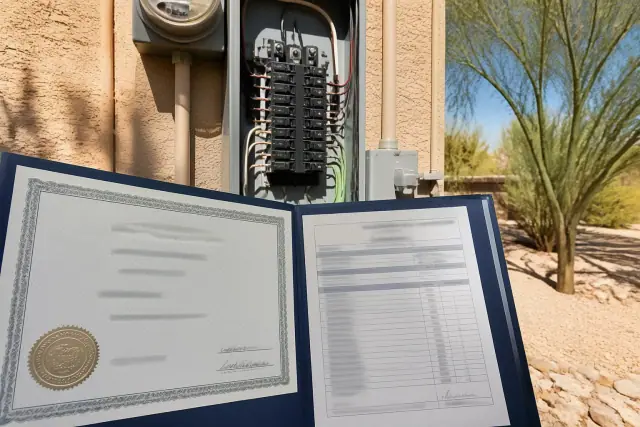
Review the ROC license number, current insurance certificate, and bond documentation together. The names and coverage details should match the contractor being considered.
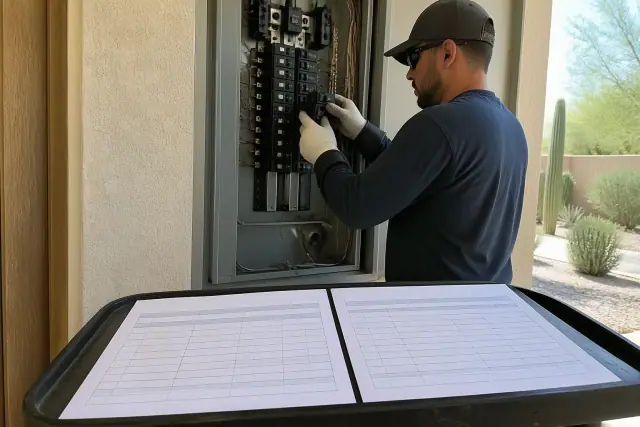
Compare estimates that separate labor, materials, permits, warranties, and timing. Phoenix rates typically run $75-$150 per hour, while defined fixture, outlet, or fan jobs often total $141-$419 depending on scope.
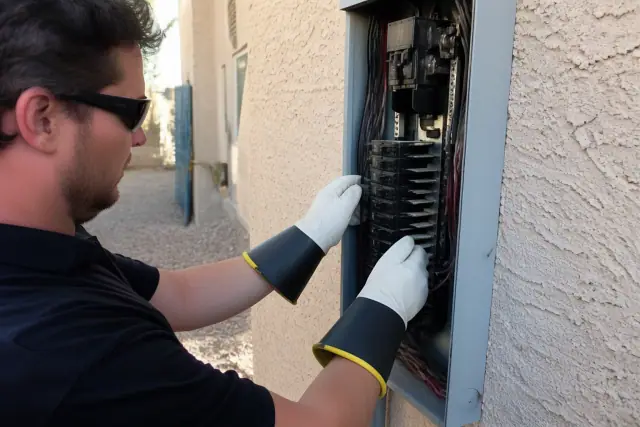
A careful panel assessment covers amperage, breaker condition, and visible wiring. Phoenix homes built before 1975 may need evaluation for aluminum wiring or outdated fuse panels.
Verify the active ROC license and request insurance and bond documentation before discussing a start date.
A licensed journeyman may suit routine outlet, fan, or fixture work; panel upgrades, whole-home rewiring, and commercial jobs call for documented experience supervising similar work.
Burning odors, warm outlet covers, multi-room flickering, sparking outlets, or a breaker that will not reset need prompt professional evaluation, especially during Phoenix's triple-digit summer heat.
Do not accept cash-only terms, a vague verbal quote, or a dramatically low bid that omits permits, insurance, material grades, or a written scope.
| Check | What to Request | Why It Matters |
|---|---|---|
| Credentials | Active ROC license number, bond status, and proof of insurance | Confirms accountability and financial protection |
| Job fit | Recent references and experience with the same project type | Matches the electrician's background to the work |
| Written scope | Itemized labor, materials, permit fees, timeline, and warranty terms | Makes competing quotes easier to compare |
| Permits | Who will obtain the required permit and schedule inspection | Keeps panel and rewiring work tied to local requirements |
| Communication | A plain-language diagnosis and answers to follow-up questions | Shows whether the recommendation is clear before work starts |
Define the project before contacting electricians because a single outlet replacement requires a different background than a panel upgrade or whole-home rewiring. Verify the contractor's license through the Arizona Registrar of Contractors, then ask for insurance, bond information, and two or three recent local references. A written estimate should itemize labor, materials, permit fees, payment terms, warranty terms, and the expected timeline. Confirm who will obtain any required City of Phoenix permit and arrange the inspection. Finally, judge communication: a qualified candidate should explain the diagnosis, applicable code issue, and proposed repair in plain language before asking for approval.
Phoenix's 1950s ranch homes and properties with aluminum wiring from the 1960s-70s can present different conditions from newer additions, so experience with the building type matters. Ask how the electrician evaluates an original 60-100 amp panel before recommending a 200-amp upgrade for modern HVAC or EV charging loads. Residential work commonly involves 100-200 amp service, while commercial projects may involve three-phase power, higher-amperage panels, and occupancy-specific provisions. The electrician should also be able to explain how the 2023 National Electrical Code and City of Phoenix amendments apply to the proposed work. For after-hours or emergency calls, ask about availability and pricing in advance; overtime rates often run 1.5 times the standard rate.
What should an electrical inspection cover? It should address panel amperage and condition, breaker function, visible wiring, outlet and switch grounding, and relevant code issues. How long might the work take? A single outlet or switch installation typically takes under an hour, a panel upgrade often takes a full day, and whole-home rewiring can span several days to a couple of weeks depending on square footage, wall access, permits, and inspections. What safety knowledge should you expect? Electricians should understand practices such as lockout/tagout and the one-hand rule, which reduces the chance of current crossing the chest when work occurs near energized components; a first-year apprentice should perform work under direct supervision while building circuit, tool, code, and safety knowledge.
Share the property type, the electrical symptoms, and the work you are considering. A local electrician can explain the likely inspection, permit, scope, and estimate details before you approve a project.